
People often talk about the Apollo moon landings or Yuri Gagarin’s first orbit as great achievements in the history of space exploration, but the story of Vladimir Komarov is a haunting reminder of how much these events cost human lives. On April 24, 1967, the world watched in silence as the Soviet Union’s ambitious Soyuz 1 mission ended in a catastrophic failure, killing its only pilot. This event is still a key moment in the Space Race because it was the first time a person died during a real spaceflight. We can better understand how brave Vladimir Komarov was and how unforgiving the final frontier is by looking at the events that led up to this tragedy.
Vladimir Komarov was born in Moscow in 1927. He was a natural mathematician and a talented pilot who quickly moved up the ranks of the Soviet Air Force. He was known for his technical skills and calmness under pressure long before he was chosen for the prestigious cosmonaut corps. These traits eventually made him a top candidate for the most dangerous missions. He became a national hero in 1964 when he commanded Voskhod 1, the first spacecraft to carry more than one person into orbit. But it was his choice to fly the first Soyuz capsule that would define Vladimir Komarov’s legacy. Many engineers whispered that the vehicle was not yet ready for human passengers.
The goal of the Soyuz 1 mission was to show off the Soviet Union’s engineering skills on a grand scale, and it was planned to coincide with the 50th anniversary of the October Revolution. The plan was very complicated. It called for a second spacecraft to launch a day later and dock with the first one manually to exchange crew members in orbit. Even though the stakes were high, the development of the Soyuz spacecraft was hampered by technical problems and tight deadlines. Reports say that technicians found more than 200 structural problems before the launch, but the Kremlin put pressure on the mission to go ahead anyway. Vladimir Komarov knew all about these risks. He even told friends that he thought he wouldn’t make it back from the flight. But he didn’t back out because his backup pilot was Yuri Gagarin, the first man in space and a close friend of Komarov’s who he wanted to protect.
The problems started almost as soon as Vladimir Komarov reached orbit on April 23, 1967, when the rocket finally cleared the launchpad. One of the two solar panels didn’t open, which left the spacecraft without power and caused big problems with the orientation and thermal control systems. For 24 hours, the cosmonaut fought a losing battle with his “devil ship,” trying to keep the capsule from tumbling while still being in touch with ground control. Even though he worked hard and came up with clever ways to solve problems, the mission was called off because it was a failure. The re-entry was scary, but Vladimir Komarov was able to steer the craft through the atmosphere, which seemed to mean he had made it through the most dangerous part of the trip.
At an altitude of about seven kilometers, the parachute system completely failed, which was a tragedy. The main parachute didn’t open, and when Vladimir Komarov released the reserve chute by hand, it got hopelessly tangled with the drogue chute. As a result, the capsule fell to the ground at terminal velocity. The impact in the Orenburg Oblast was so strong that it flattened the capsule and set off the other soft-landing rockets, which caused a huge fire. Many Western myths say that he spent his last moments cursing his bosses over the radio, but official records show that Vladimir Komarov stayed professional until the end, reporting his coordinates and system statuses until the moment of impact.
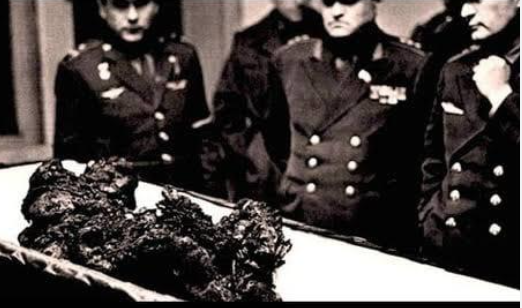
The Soviet space program was in a state of mourning and reflection after the crash. Vladimir Komarov’s family and friends may have done this as a final act of defiance, or they may have done it at his request. At the open-casket funeral, the charred remains of the hero were on display for high-ranking officials to see. This sad picture is still one of the most powerful ones from the Cold War. It shows how dangerous it was to put your life on the line for your country. The death of Vladimir Komarov led to major safety changes in the Soyuz program, making the craft one of the safest vehicles ever. It still takes crews to the International Space Station today.
Both his former rivals and his fellow countrymen honor Vladimir Komarov’s legacy today. The Apollo 15 crew left a plaque on the Moon with his name on it. This shows that the search for the stars goes beyond borders and political beliefs. We remember Vladimir Komarov not only as a victim of a broken system, but also as a very brave man who went into the unknown so that others could follow him safely. His story still inspires modern aerospace engineers to put safety ahead of speed. This way, we will always remember the lessons learned from Vladimir Komarov’s death as we look to Mars and beyond.