
If you’ve ever tried to stream video from a mountain cabin or run a business from a remote worksite, you know the frustration of spotty internet. Satellite internet has quietly solved that for millions of people, and Starlink is the name most people know. But how does beaming a signal to space and back actually work? This guide breaks down satellite internet in plain English: how Starlink and similar low Earth orbit networks deliver connectivity, how they compare to fiber, what they cost, and whether one is worth it for you.
What Is Satellite Internet?
Satellite internet uses spacecraft orbiting Earth to relay data between your home and the wider internet, instead of relying on buried cables or phone lines. A dish at your location talks to a satellite overhead, which passes your request along until it reaches a ground facility connected to the internet backbone. The concept has existed for decades; what changed recently is where those satellites sit, and that shift is why Starlink feels so different.
From Geostationary Dishes to Low Earth Orbit
Older providers like HughesNet and Viasat use geostationary satellites parked about 22,000 miles above the equator. One satellite covers a huge area, but the distance causes a noticeable round trip, often over half a second of lag, or latency, which makes video calls and gaming painful. Starlink and its newer competitors instead use low Earth orbit, roughly 340 to 560 miles up. Being closer cuts latency dramatically, but each satellite only sees a small patch of Earth, so the network needs thousands working together instead of just a few.
How Does Starlink Actually Work?
Starlink’s system comes down to four moving parts: your dish, the satellite constellation, ground stations, and the internet backbone they all connect to.
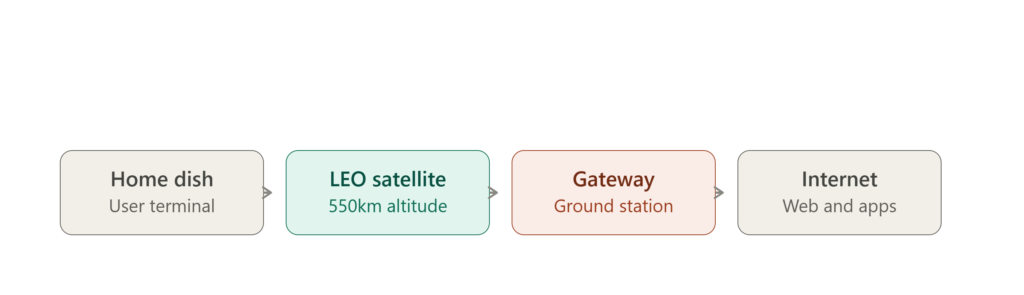
The Four-Step Journey of Your Data
Here’s the path a single request, like loading a webpage, takes. First, your Starlink dish, a flat antenna with no moving parts, sends the request skyward, electronically steering its beam to track satellites moving at roughly 17,000 miles per hour. Second, the nearest satellite forwards the signal to a ground station, or to another satellite. Third, the ground station, or gateway, converts the signal and routes it into fiber-optic lines. Fourth, your request reaches its destination, and the process runs in reverse, typically in well under a tenth of a second.

Laser Links: Satellites Talking to Each Other
Newer Starlink satellites carry laser inter-satellite links, bouncing data from satellite to satellite in space before it touches the ground. This matters most over oceans, polar regions, and other spots without a nearby ground station: data can hop several satellites away and come down wherever coverage exists, a big reason Starlink can serve places no cable ever will.
Satellite Internet vs. Traditional Broadband
How does this stack up against the cable or fiber you might already have? Fiber wins on raw latency, often under 10 to 20 milliseconds, and on price per megabit in cities, but it never reaches many rural roads, mountain towns, or islands. Starlink’s typical latency sits around 25 to 60 milliseconds, low enough for video calls and cloud gaming, with download speeds generally ranging from 50 to over 200 Mbps depending on plan and congestion. Satellite internet won’t outrun fiber in a speed test, but it beats having no reliable option at all.
Beyond Starlink: Who Else Is Building These Networks?
Starlink dominates headlines, but it isn’t the only satellite internet provider racing to close coverage gaps.
Amazon Leo (Formerly Project Kuiper)
Amazon rebranded Project Kuiper as Amazon Leo in late 2025 and is rolling out commercial and enterprise service through 2026. It has regulatory approval for over 3,200 satellites and has already signed partners like JetBlue, positioning itself around enterprise-grade reliability and gigabit terminals to compete directly with Starlink.
OneWeb, AST SpaceMobile, and China’s Guowang
Eutelsat OneWeb focuses on business and government connectivity with a smaller fleet. AST SpaceMobile and Starlink’s own direct-to-cell feature are working toward connecting ordinary smartphones straight to satellites, no dish required, useful for emergency texts in dead zones. China’s state-backed Guowang constellation is also steadily growing. None yet match Starlink’s scale, but the competition is pushing prices down and coverage up.
How Much Does Satellite Internet Cost?
Starlink’s residential plans generally start around $55 to $85 a month for entry-level speeds, with a premium tier near $130, plus a one-time hardware fee of a few hundred dollars for the dish and router. Business and maritime plans cost considerably more. Pricing varies by region and congestion and has shifted more than once, so check current availability for your address before committing. Compared to older satellite services charging similar amounts for a fraction of the speed, the value has improved significantly.
Is Satellite Internet Right for You?
Best Use Cases
- Rural or off-grid homes with no cable or fiber access
- RVs, boats, and remote worksites needing internet on the move
- Backup connectivity for businesses that can’t afford downtime
- Disaster recovery when ground infrastructure is damaged
- Aviation and maritime connectivity for passengers and crew
Limitations Worth Knowing
- Higher upfront hardware cost than a cable modem
- Speeds can dip during peak hours in crowded areas
- Trees, buildings, and obstructions can block the signal
- Severe weather can occasionally interrupt service
- Monthly cost runs higher than many wired broadband plans
The Future of Satellite Internet
Expect more competition as Amazon Leo scales up, wider direct-to-cell coverage turning ordinary phones into satellite-connected devices during emergencies, and gradually falling prices as constellations mature. Regulators are also watching orbital congestion and space debris closely as satellite counts climb into the tens of thousands.
Final Thoughts
Satellite internet has gone from a last-resort option to a genuinely competitive way to get online, especially where fiber and cable don’t reach. Starlink built its lead by moving satellites closer to Earth and launching them by the thousand, but Amazon Leo and other challengers are closing the gap fast. If reliable internet has always felt out of reach where you live or work, satellite internet might finally be the answer.