
Your phone loads a 4K video before you’ve even finished tapping play. A surgeon in one city guides a robotic arm in another, in real time. A factory floor full of machines talks to itself, adjusting on the fly. None of this runs on luck — it runs on the 5G network. If you’ve ever wondered what 5G actually is, how it differs from 4G, or why it’s suddenly everywhere, this guide breaks it down in plain English.
What Is a 5G Network?
5G stands for fifth generation, the newest standard in mobile network technology, following 2G, 3G, and 4G LTE. A 5G network is built to move far more data, at much higher speeds, with far lower lag — or latency — than earlier networks. Where 4G opened the door to mobile video and app-driven life, 5G is designed for a world of billions of connected devices, from phones to self-driving cars. Global 5G subscriptions passed the three billion mark during the first quarter of 2026, with more than 390 service providers now offering commercial 5G, over 90 of them running 5G Standalone networks.
How Does a 5G Network Work?
5G works by combining new radio technology, smarter antennas, and a redesigned network core. Instead of relying on a handful of giant towers, 5G uses a dense web of transmitters and advanced signal processing to pack more data into the airwaves.
5G Frequency Bands: Low, Mid, and High-Band
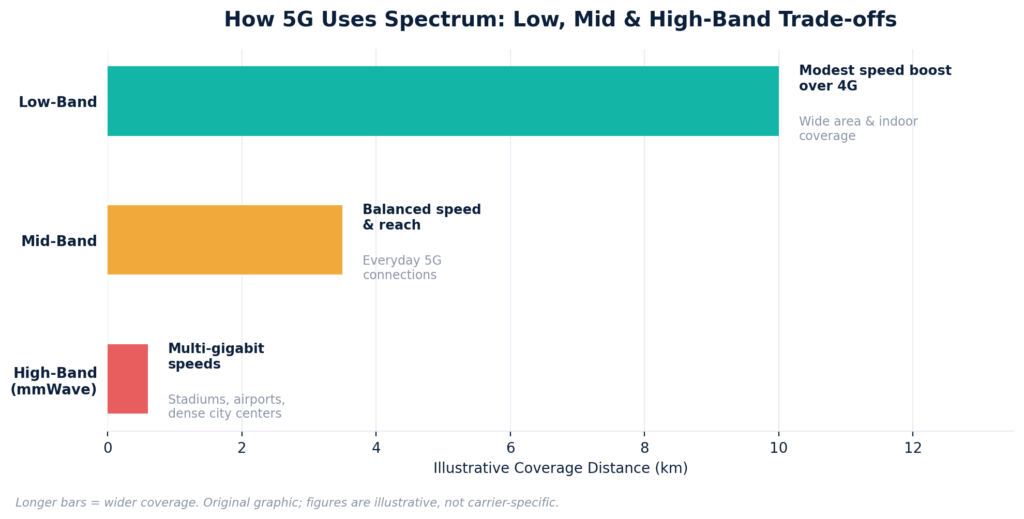
5G networks operate across three types of spectrum. Low-band frequencies travel far and pass through walls well, but offer only modest speed gains over 4G. Mid-band frequencies strike a balance of speed and reach, and power most everyday 5G connections. High-band, or mmWave, delivers speeds of several gigabits per second, but only over short distances — found mainly in stadiums and dense city centers.
Massive MIMO and Beamforming
5G towers use massive MIMO antennas — short for multiple input, multiple output — handling dozens of data streams at once instead of one. Paired with beamforming, which focuses the signal directly at your device instead of every direction, this boosts both speed and network capacity in crowded areas.
Network Slicing
One of 5G’s most powerful tricks is network slicing: splitting one physical network into several virtual ones, each tuned to a specific job. A hospital might get an ultra-reliable slice for remote surgery, while a smart city gets a high-capacity slice for thousands of traffic sensors, all on the same shared infrastructure.
Edge Computing
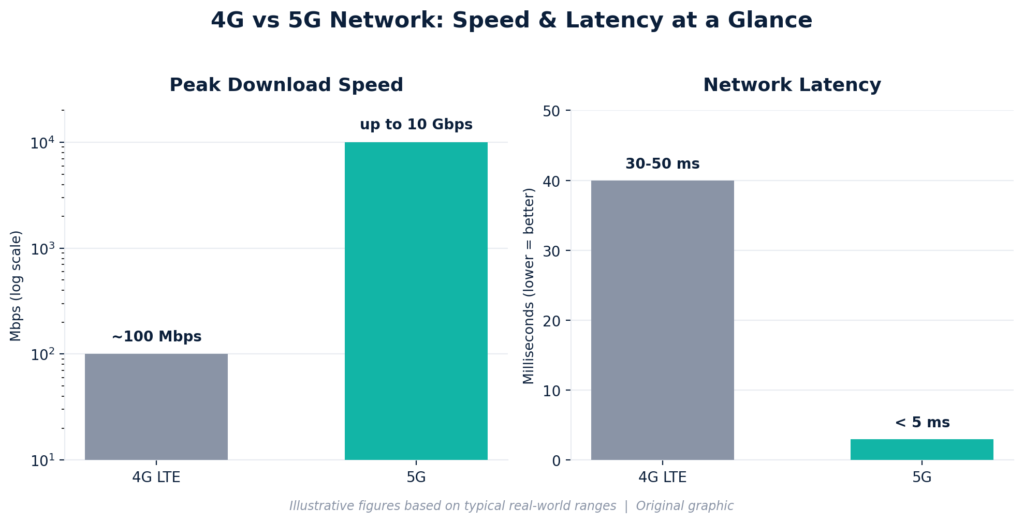
5G also pushes data processing closer to the user through edge computing, cutting the distance information has to travel. That’s a big part of how 5G achieves latency as low as 1 millisecond, compared to roughly 50 milliseconds on typical 4G connections.
5G vs. 4G: What’s the Difference?
- Speed: 4G tops out around 100 Mbps in real-world use; 5G can reach several Gbps.
- Latency: 4G latency runs 30–50 milliseconds; 5G latency can fall under 5 milliseconds.
- Capacity: 5G supports roughly 1 million connected devices per square kilometer, versus about 100,000 on 4G.
- Coverage design: 5G blends low-band reach with mid- and high-band speed, instead of relying on a single band tier.
Key Benefits of a 5G Network
- Faster downloads and near-instant streaming, even in 4K or 8K
- Lower latency for gaming and video calls
- Room for many more connected devices without congestion
- A stronger foundation for smart cities and industrial automation
- New options for home internet without cable lines
Real-World Applications of 5G
- 5G home internet: a genuine cable alternative in many neighborhoods
- Healthcare: remote diagnostics and robot-assisted surgery
- Manufacturing: private 5G networks coordinating robots and sensors in real time
- Transportation: connected and self-driving vehicles talking to traffic systems instantly
- Entertainment: smooth cloud gaming and AR/VR on mobile devices
Challenges and Limitations of 5G
5G isn’t without hurdles. Building the dense small-cell networks that high-band 5G needs is expensive, which slows rollout in rural areas. Older phones can’t access 5G without a hardware upgrade, and mmWave’s short range means indoor coverage can be spotty. Security matters more too, since more connected devices create a larger attack surface, pushing operators to invest in 5G-specific safeguards.
What Comes After 5G? 5G-Advanced and 6G
Carriers are now layering in 5G-Advanced, which adds AI-driven network optimization and stronger uplink performance. Uplink data traffic is already growing faster than downlink on many 5G networks. Early 6G research is underway too, aiming for terahertz speeds sometime next decade. For now, though, 5G still has years of growth ahead — global subscriptions are forecast to more than double, to 6.4 billion, by 2031.
Frequently Asked Questions About 5G Network
Is a 5G Network Safe?
Yes. 5G uses non-ionizing radio waves, the same category as Wi-Fi and 4G, and stays within the radiation exposure limits set by international health regulators.
Do I Need a New Phone for 5G?
Yes — 5G requires a compatible modem, so older 4G-only phones won’t connect. Most phones released since 2022 support 5G.
How Much Faster Is 5G Than 4G?
In ideal conditions, 5G can run 10 to 100 times faster than 4G, though real-world speeds depend on your carrier, location, and device.
Final Thoughts
5G network technology is quietly becoming the backbone of modern life — powering faster phones, smarter cities, and industries that finally run in real time. Whether you’re upgrading your phone plan or just curious how it works, understanding 5G helps you see where mobile networks are headed next. With adoption already past three billion subscribers worldwide, one thing is clear: 5G isn’t the future anymore — it’s already here.