
Picture a day with no wristwatch, no phone lock screen, and no clock tower chiming the hour. For most of human history, that was simply reality. Yet ancient civilizations still managed to plant crops on schedule, hold religious ceremonies at precise moments, and coordinate armies across entire empires. How did they do it? By reading the sun, the stars, water, fire, and sand. Long before the first mechanical clock ever ticked, humans built remarkably clever tools to measure something as invisible as time itself. Here’s how ancient civilizations told time before clocks — and what their ingenuity still has to teach us.
Why Timekeeping Mattered in the Ancient World
Time wasn’t just a curiosity for early societies — it was survival. Farmers needed to know when to plant and harvest. Priests needed exact moments for rituals and festivals. Traders needed to schedule caravans and voyages. Because so much depended on precision, ancient timekeeping methods evolved quickly, growing more accurate with every civilization that took a turn improving them.
The Sun as the First Clock
Shadow Sticks and Sundials
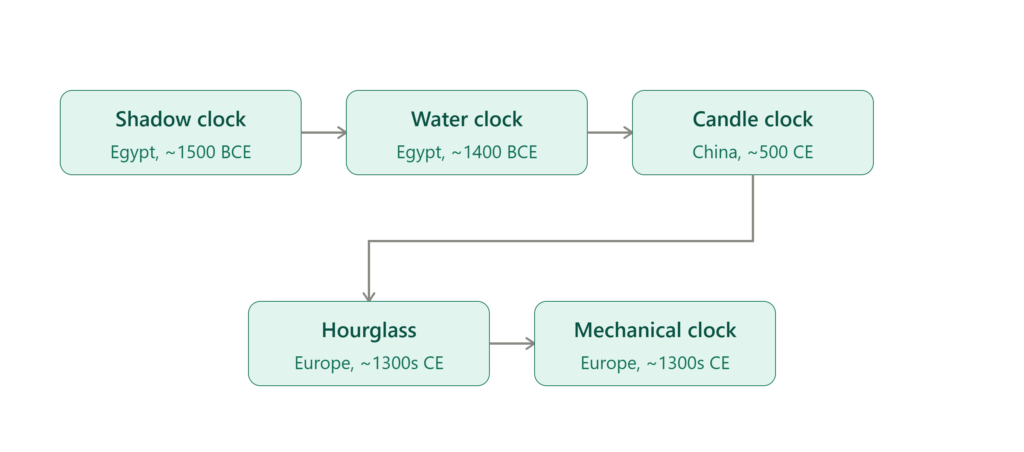
The earliest and simplest timekeeping tool was a stick in the ground. As the sun moved across the sky, its shadow shifted, giving early humans a rough sense of the hour. The ancient Egyptians formalized this idea around 1500 BCE with the shadow clock, a T-shaped device whose shadow crept along a marked base. The Babylonians and Greeks later refined it into the sundial, adding curved dials and precise angles that accounted for the sun’s seasonal path.
Egyptian Obelisks as Giant Timepieces
Egypt’s towering obelisks weren’t just religious monuments — they doubled as massive sundials. Their long shadows swept across the ground, letting priests and officials track the hours and even mark the changing seasons. It’s a striking example of ancient engineering solving two problems, spiritual and practical, at once.
Water Clocks: Measuring Time When the Sun Went Down
How the Clepsydra Worked
Sundials had an obvious flaw: they were useless at night or on cloudy days. The solution was the clepsydra, or water clock, which measured time by the steady drip of water from one container to another. Markings on the vessel showed how much time had passed as the water level dropped. Egyptian records place the clepsydra’s origins around 1400 BCE, making it one of the oldest known timekeeping instruments.
Water Clocks Across Cultures
The idea spread and evolved. Greek engineer Ctesibius built a more accurate clepsydra with a constant flow rate around the 3rd century BCE. Centuries later, Tang dynasty China took water clocks to astonishing heights of complexity — astronomer Su Song’s 11th-century water-powered clock tower combined timekeeping with astronomical observation, complete with a mechanism that struck bells and gongs on the hour.
Candle and Incense Clocks: Timekeeping by Fire
Fire offered another way to track time’s passage. In parts of medieval Europe, candle clocks were marked with evenly spaced lines; as the candle burned down, each line marked a fixed interval. England’s King Alfred the Great reportedly used marked candles to divide his day into structured blocks for prayer, work, and rest.
In ancient China and later Japan, incense clocks took this concept further. Sticks or coils of incense burned at a predictable rate, and some were even designed to release different scents at different times — a fragrant, multisensory way of knowing the hour without glancing at anything.
The Hourglass: Time Trickling Through Sand
The hourglass, with sand flowing between two glass bulbs, is believed to have emerged in Europe sometime around the 8th century, though it became widespread by the 14th century. Unlike water clocks, sand didn’t evaporate or freeze, making the hourglass especially useful at sea. Sailors relied on them to time shifts and navigation calculations, cementing the hourglass as a trusted maritime tool for centuries.
Reading the Sky: Stars, Moon, and Calendars
Lunar and Solar Calendars
Beyond the hour, ancient civilizations also needed to track longer stretches of time. The Babylonians developed detailed lunar calendars based on the moon’s phases, while the Egyptians created a 365-day solar calendar tied to the flooding of the Nile. The Maya independently built extraordinarily precise calendar systems, blending astronomical observation with religious cycles.
Stonehenge and Astronomical Alignments
Some ancient structures functioned as calendars carved in stone. Stonehenge, built in stages starting around 3000 BCE, aligns with the sunrise and sunset of the summer and winter solstices. Structures like it show that tracking time wasn’t confined to portable tools — entire monuments were engineered to mark the passing of seasons.
What Ancient Timekeeping Teaches Us Today
These early systems weren’t just primitive workarounds; they reveal a deep human instinct to find rhythm and order in nature. A few takeaways still worth carrying forward:
- Observe your natural environment. Ancient timekeepers paid close attention to sunlight, seasons, and natural cycles — a habit modern life often drowns out.
- Simplicity can be remarkably effective. A stick and a shadow measured time accurately for thousands of years.
- Innovation builds on what came before. Each civilization refined the last generation’s methods rather than starting from scratch — a reminder that progress is rarely a single leap.
Frequently Asked Questions
What was the first way humans told time before clocks?
The earliest method was likely observing shadows cast by the sun, later formalized into shadow clocks and sundials by the ancient Egyptians.
Which ancient civilization had the most accurate timekeeping methods?
Ancient China is often credited with the most sophisticated systems, particularly Su Song’s 11th-century astronomical water clock tower.
When were mechanical clocks invented?
The first mechanical clocks appeared in Europe in the late 13th and early 14th centuries, eventually replacing sundials, water clocks, and hourglasses.
Final Thoughts
From shadow sticks to water clocks to candle flames, ancient civilizations told time using nothing but careful observation and clever engineering. Their methods laid the groundwork for every clock we rely on today — proof that humanity’s fascination with time is as old as civilization itself.