
Bluetooth has been quietly powering your earbuds, fitness tracker, and car stereo for over two decades, evolving so gradually most people never notice the version number. That changes with Bluetooth 6. Rather than chasing faster file transfers, this update focuses on something far more practical: helping your devices know exactly where they are, connect faster, and last longer on a charge. Here’s what Bluetooth 6 actually is, what changed under the hood, and how it makes the gadgets you already own smarter — no engineering degree required.
In short, Bluetooth 6 is the latest generation of the Bluetooth wireless standard, and its biggest upgrade, Channel Sounding, lets two devices measure the exact distance between them for the first time. That single feature quietly improves item trackers, digital car keys, smart locks, and battery life across millions of everyday gadgets.
What Is Bluetooth 6?
Bluetooth 6.0 is the newest generation of the Bluetooth Core Specification, released by the Bluetooth Special Interest Group in September 2024. It builds on Bluetooth 5.x rather than replacing it, so think of Bluetooth 6 as a precision and efficiency layer added on top of the wireless standard billions of devices already use. Rather than chasing faster data rates, it’s designed to make Bluetooth smarter at ranging, scanning, privacy, and energy use — three practical wins: pinpoint distance tracking, smarter power management, and tighter security.
Bluetooth 6 vs Bluetooth 5: What Actually Changed
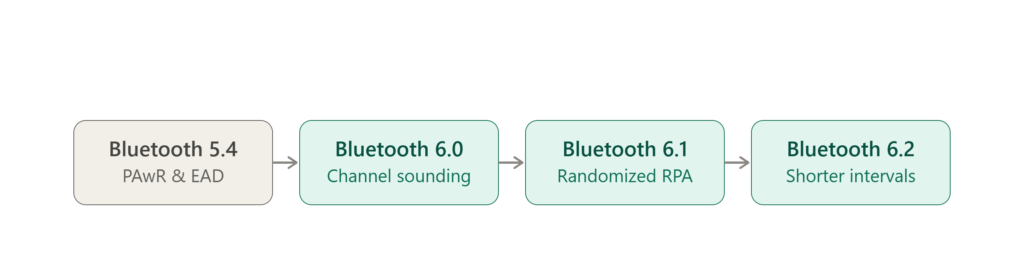
Bluetooth got its last major location upgrade back in 2019 with the 5.1 standard, which introduced Angle of Arrival and Angle of Departure to give devices a rough sense of direction. The version directly before Bluetooth 6.0, Bluetooth 5.4, arrived in February 2023 and took a different path: its Periodic Advertising with Responses (PAwR) and Encrypted Advertising Data features focused on efficient, secure one-to-many broadcasting for things like electronic shelf labels and wireless battery management systems, rather than location. Bluetooth 6 builds on both by adding true distance measurement, more efficient scanning, and lower-latency data handling.
| Version | Released | Headline Feature | Main Benefit |
| Bluetooth 5.1 | Jan 2019 | Angle of Arrival/Departure | Rough direction finding |
| Bluetooth 5.4 | Feb 2023 | Periodic Advertising with Responses | Efficient one-to-many broadcasting |
| Bluetooth 6.0 | Sept 2024 | Channel Sounding | Precise distance measurement |
| Bluetooth 6.1 | May 2025 | Randomized RPA | Better privacy and battery life |
| Bluetooth 6.2 | Nov 2025 | Shorter Connection Intervals | Near-instant responsiveness |
Key Features of Bluetooth 6.0
Channel Sounding: Centimeter-Level Accuracy
The headline feature is Bluetooth Channel Sounding — a technique that enables secure fine ranging, or distance measurement, between two Bluetooth devices. It uses phase-based ranging and round-trip time measurements to enable this fine ranging between two connected devices, while securing distance measurement against man-in-the-middle attacks that plagued older signal-strength-based methods. In practice this delivers accuracy in the range of roughly 0.3 to 1 meter, a major leap from earlier Bluetooth ranging.
Smarter Scanning: DBAF and Monitoring Advertisers
Decision-Based Advertising Filtering lets a scanning device use the content of a packet received on the primary channel to decide whether it’s worth scanning related packets on the secondary channels, cutting wasted scanning time. Paired with the new Monitoring Advertisers feature, which lets a device watch other devices moving in and out of range, phones and hubs spend far less energy chasing irrelevant signals.
Faster Data and Smoother Streaming
Enhancements to the Isochronous Adaptation Layer, an extended link-layer feature set, and a frame-spacing update reduce latency for time-sensitive data, helping wireless earbuds and hearing aids stay in sync with less lag.
Bluetooth 6.1 and 6.2: The Story Continues
The Bluetooth SIG has since moved to a twice-yearly release cadence, so “Bluetooth 6” isn’t a single moment but an ongoing rollout. Bluetooth 6.1 arrived in May 2025 with Randomized Resolvable Private Address updates, which randomize the timing of a device’s address changes to make long-term tracking harder while offloading the work to the controller to help save battery. Bluetooth 6.2 followed in November 2025, cutting the minimum Bluetooth LE connection interval from 7.5 milliseconds down to just 375 microseconds for much faster responsiveness, alongside stronger defenses against radio-frequency attacks and a new mode built for USB Bluetooth audio devices.
How Bluetooth 6 Improves Your Everyday Devices
Precise Item Finding
Lost-item trackers and phone-based finding features stand to benefit most, since Channel Sounding gives devices true distance awareness instead of a rough signal-strength guess — the difference between “somewhere in this room” and “under the couch cushion.”
Digital Keys and Smart Locks
Because Channel Sounding measures real distance with strong security, it’s well suited to digital keys for cars, doors, gates, and even bikes, and is emerging as a key technology for secure office access and hands-free vehicle entry.
Longer Battery Life and Better Audio
Smarter scanning and address management mean less constant radio chatter, which adds up to noticeably longer battery life for earbuds, trackers, and smart-home sensors, while the streaming enhancements keep audio better synced.
Is Your Device Ready for Bluetooth 6?
Bluetooth 6 is backward compatible, so existing Bluetooth 5 gadgets keep working exactly as before. However, features like Channel Sounding need new radio hardware, not just a software update, so only devices launched from late 2024 onward can actually use it. Expect adoption to arrive gradually through new phones, earbuds, trackers, and smart-home accessories rather than all at once.
Frequently Asked Questions
Is Bluetooth 6 the same as Bluetooth LE?
Yes. Bluetooth 6.0 builds on Bluetooth Low Energy rather than replacing it, inheriting BLE’s low power draw while adding new ranging and efficiency features on top.
Do I need a new phone to use Bluetooth 6.0?
In most cases, yes. Channel Sounding and the other headline features require new radio hardware, so only devices released from late 2024 onward can support them.
Does Bluetooth 6 replace Wi-Fi or UWB?
No. Bluetooth 6 is built for short-range, low-power connections. It narrows the gap with Ultra-Wideband for distance sensing but doesn’t replace Wi-Fi for high-bandwidth tasks like video streaming.